- Our services are free, there are no costs to the client. Schedule your consultation.
- (+351) 96 69 13 252
- (+351) 291 22 44 55
- info@visaofinanceira.com

 Informação Legal
When is it worth making a transfer of the home loan?

Making the transfer of the housing loan is a way to obtain better conditions and reduce costs throughout the contract. However, the decision should not be automatic. It is important to understand when there are signs that you are paying more than you should and evaluate how much you can save after considering the costs of the transfer itself.
This guide helps to identify those signs and explains when changing to another bank may make sense.
What does it mean to transfer the housing loan?
Transferring the housing loan consists of moving the loan from the current bank to another institution that offers more competitive conditions. The goal is to reduce the monthly payment, improve the interest rate, adjust insurance, or achieve greater stability throughout the contract.
It is a process possible at any stage of the loan, but it should be analyzed carefully, as it involves new costs and depends on your current financial profile.
Signs that it may be time to transfer your housing loan

Many people keep their loan with the same bank for years without reviewing the conditions. However, there are some simple indicators that can show that you are paying more than necessary.
Spread above current rates
If you took out the loan a few years ago, it is likely that the spread is above the conditions practiced today. A lower spread has a direct impact on the monthly payment.
High costs associated with insurance
Some banks require life and multi-risk insurance with uncompetitive conditions. Changing to another institution may allow you to review these insurances and also the amounts you pay for them.
Declining Euribor
When the Euribor declines, many banks adjust their offers to attract new customers. If your contract does not reflect this trend, you may be missing an opportunity to save.
Outdated conditions compared to your current profile
If over the years you have increased your income, improved your job stability, or reduced expenses, your financial risk may be lower than at the time of contracting. This may justify a new bank offering you more advantageous conditions.
Transfer of the housing loan: costs to consider

Despite the potential savings, it is essential to know the costs involved in the transfer:
- Early repayment fee at the current bank: some banks charge a fee for early repayment of the contract. For loans with a variable rate, this fee is usually reduced.
- Valuation and new risk assessment fee: the new bank always conducts a property valuation and a risk assessment of the client. These steps have associated costs.
- Registration and documentation costs: the transfer involves updating records and issuing new documentation, with variable costs.
These amounts should not be ignored. The important thing is to compare the costs with the total savings over the new contract.
Potential savings: how to determine if the transfer is worthwhile
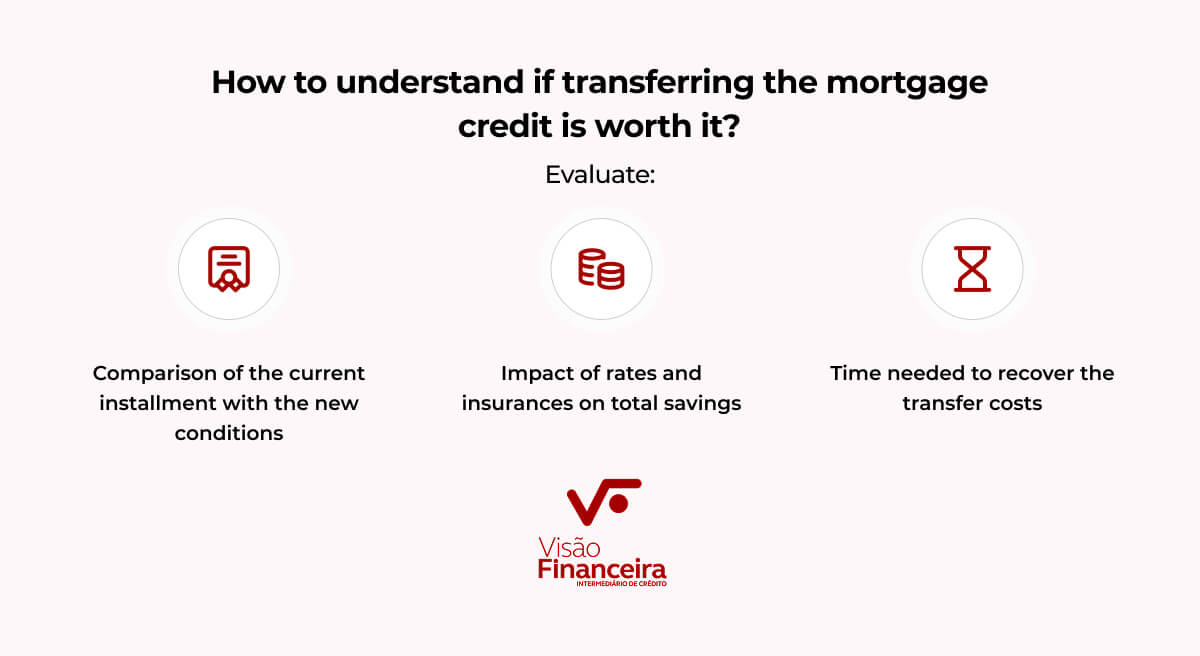
To know if transferring the housing loan is worthwhile, you should compare two elements: immediate costs and future savings.
Comparison of the current payment with the new conditions
If the monthly payment is significantly lower at the new bank, the accumulated savings may offset the transfer costs.
Impact of rates and insurance on total savings
Reducing the spread or paying less for associated insurance can have a significant impact on the amount paid over the years.
Time needed to recover the transfer costs
It is important to calculate how many months it takes for the savings to exceed the initial costs. In many cases, this break-even point is reached quickly, but it depends on the contract and the current rate.
Why the analysis of the housing loan transfer should be personalized
Each client has a different financial situation. Age, income, employment status, effort rate, and existing expenses influence the risk analysis and, consequently, the conditions presented by the bank.
Moreover, two loans with the same amount and term may have different costs due to insurance or fees. Therefore, automatic simulations are only indicative and do not replace a careful evaluation.
Before proceeding, it is essential to understand the impact of the new conditions on your specific case. A personalized analysis helps avoid mistakes and identify the most favorable option.
How Visão Financeira can support the decision to transfer the loan

Visão Financeira compares proposals from various banks and presents alternatives tailored to your profile. The support includes:
- independent analysis of current conditions
- comparison between banks
- review of associated insurance
- clarification of doubts about costs and savings
- follow-up until the process is completed
All of this at no cost to you, as the remuneration is provided by the banks we collaborate with.
Request an independent analysis before proceeding with the transfer of your housing loan
Transferring the housing loan can generate real savings, but it only makes sense when the numbers are on your side. The best way to confirm is through an analysis based on your case.
If you want to understand if changing to another bank is advantageous, you can request an independent analysis from Visão Financeira. This way, you make a secure decision tailored to your budget.